
Create & Apply
Analyze & Prepare
Free Tools
All Free Tools
Browse keyword extractor, ATS checker, bullet rewriter, and more
Keyword Extractor
Extract skills and keywords from any job description
ATS Resume Checker
Check resume keyword match against a job description
Bullet Rewriter
Rewrite resume bullets with stronger impact
Summary Generator
Generate professional resume summary variants
Build your perfect tailored CV
Join thousands of professionals landing more interviews with AI-powered resumes.
Popular Roles
See real resumes that get interviews
Browse examples across every industry and role to inspire your own.
Find your perfect template
Professionally designed layouts ready to tailor to any job.
Learn & Explore
May 28, 2026
·7 min read
AI Researcher Resume Guide: ATS Tips and Examples
Discover the best AI researcher resume ATS tips, essential skills, and strategies to stand out and land top research opportunities.

Creating a strong AI Researcher resume is not about listing your technical skills and job responsibilities. Employers and hiring managers want to see why you are the right fit for this role and how you stand out from your competitors. A strong AI Researcher CV should clearly demonstrate your expertise in artificial intelligence, data science, machine learning, and analytical thinking.
So, whether you are applying for an academic or junior role, your resume needs to showcase both your job capabilities and your ability to deliver real, measurable results. Follow our expert writing guide to present your achievements, research experience, and technical strengths in a way that stands out to hiring managers.
AI Researcher Resume Example
Here’s what a strong AI Researcher CV should look like, highlighting all the important sections.
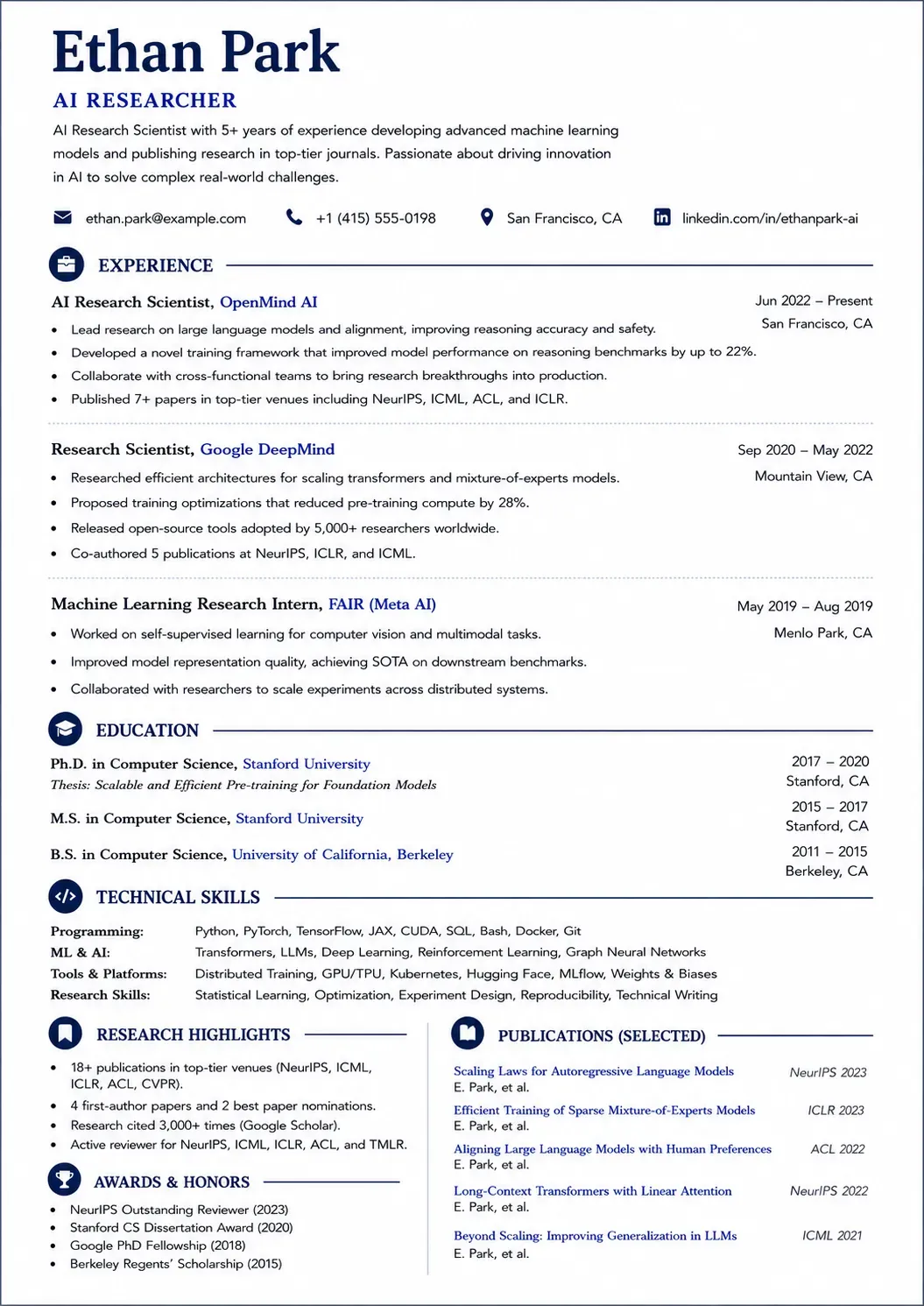
Why This CV Works
This AI Researcher CV format is an excellent way to showcase your capabilities, highlight your key achievements with technical skills needed. This way, you can improve your resume efficiency, pass the ATS filters, and land more interviews. You can also use our AI Researcher CV builder.
How to Structure Your AI Researcher Resume
To truly stand out, you need to showcase your unique contributions, problem-solving abilities, and passion for the subject. Building a strong personal brand, through a well-rounded research portfolio, impactful projects, and a deep understanding of your role, can set you apart from the crowd.
In the following sections, we’ll break down the key elements to focus on when building your AI researcher CV.
Professional Summary
Start your CV with a professional summary that emphasizes your strengths and career goals.
Example:
“AI Research Scientist with 5+ years of experience developing advanced machine learning models and publishing research in top-tier journals. Passionate about driving innovation in AI to solve complex real-world challenges.”
This sets the tone for your CV and immediately captures the recruiter’s interest.
Research and Work Experience
This is the most important section of your AI researcher resume. The hiring managers want to know what you did, how you did it, and what happened as a result. List relevant roles, and keep each role to 3–5 bullets to highlight your achievements.
A few things to keep in mind:
- List experience in reverse chronological order (the most popular format).
- Separate academic and industry experience if you have both.
- Quantify wherever you can.
So, instead of writing:
"Responsible for developing machine learning models for computer vision tasks."
You write:
"Designed a convolutional neural network for real-time object detection, reducing inference time by 40% while maintaining 94% accuracy on the COCO benchmark".
Technical Skills
AI Research Scientists must excel in several technical areas to drive impactful research and innovation.
Key skills include:
- Programming: Proficiency in Python, R, or C++ is essential. Additionally, experience with frameworks like TensorFlow, PyTorch, and Scikit-learn is highly valuable.
- Mathematics: A solid foundation in linear algebra, calculus, probability, and statistics is critical for developing machine learning models.
- Machine Learning: Expertise in supervised and unsupervised learning, neural networks, and reinforcement learning is a must. AI in robotics is also a sought-after skill, and you may benefit from incorporating aspects of mechanical engineering resume writing tips.
AI Research Scientists often present their findings to stakeholders, collaborators, and non-technical audiences. Effective communication skills involves:
- Writing clear, concise research papers and reports.
- Delivering compelling presentations at conferences or to stakeholders.
- Explaining complex concepts to non-technical team members.
Education
For AI Research Scientist roles, education is important. Include details of your degrees, theses, and any specialization in AI-related fields like machine learning, robotics, or data science.
Example:
PhD in Artificial Intelligence
University of XYZ, 2023
Dissertation: “Advancing Neural Networks for Real-Time Image Recognition”
If you’ve worked in AI-focused industries, describe how your work translated research into real-world applications.
Quantify your impact wherever possible:
- “Improved model accuracy by 15% using advanced neural network techniques.”
- “Reduced computation time by 30% through optimized algorithms.”
If transitioning from academia to industry, highlight transferable skills such as collaboration, problem-solving, and innovation.
Certifications
Include relevant industry certifications to strengthen your CV and demonstrate your expertise. Certifications can help you stand out from other candidates by showcasing additional technical knowledge, commitment to professional development, and up-to-date industry skills valued by employers.
Some examples for AI Researcher certification include:
- Coursera Machine Learning Specialization
- edX HarvardX CS50’s Introduction to Artificial Intelligence with Python Certificate
- Massachusetts Institute of Technology MITx MicroMasters Program in Statistics and Data Science
- Google Cloud Professional Data Engineer Certification
- Microsoft Azure AI Fundamentals (AI-900) Certification
Projects (Additional Section)
AI research isn’t just theoretical - it’s about solving complex problems. Highlight projects that demonstrate:
- Real-World Impact: For example, “Designed an NLP model that increased sentiment analysis accuracy by 20%.”
- Innovation: Mention unique approaches or breakthroughs you achieved.
- Collaboration: Many roles require teamwork; emphasize cross-functional projects where applicable.
By showcasing these elements, you’ll not only prove your technical expertise but also your ability to make a tangible difference in the field.
Tips to Optimize Your AI Researcher CV for ATS
When applying for AI researcher positions, it’s important to optimize your CV not only for human recruiters but also for Applicant Tracking Systems (ATS). Many companies use ATS to streamline the hiring process, scanning CVs for specific keywords and formatting.
Key strategies to optimize for ATS and recruiters include:
- Relevant Keywords: Incorporate key terms that match the job description. This includes specific AI-related terms like "machine learning," "deep learning," "natural language processing," and "algorithm development." These are the keywords hiring managers look for in resumes and ATS systems use them to determine if your skills align with the job.
- Simple Formatting: Avoid overly complex formatting, such as images, text boxes, or fancy fonts. ATS systems may have difficulty parsing these elements, so stick to standard fonts (like Arial or Times New Roman) and a clear, simple layout. The best resume format will ensure your experience and skills are presented clearly and effectively.
- Use Standard Headings: Ensure you use typical section headings like "Experience," "Education," "Skills," and "Research," as ATS systems are trained to look for these common labels.
- Tailor Your CV: Customize your CV for each application by closely matching your experience and skills with the specific requirements outlined in the job posting. ATS software looks for a strong match between the job description and the candidate's CV.
- Highlight Soft Skills: While ATS may focus on technical expertise, recruiters are often interested in seeing your soft skills as well. Emphasize collaboration, problem-solving, and leadership abilities within your experience and projects.
By optimizing your CV for both ATS and recruiters, you'll increase your chances of making it through the initial automated screenings and catching the attention of hiring managers.
Conclusion
Standing out with your AI Researcher resume requires a combination of technical skills, practical experience, and a clear, well-organized CV. Focusing on these key areas will improve your chances of catching the attention of hiring managers and recruiters. The AI field is competitive, but with a targeted approach to building your CV, you will be better positioned to advance in your career and secure the right opportunities. Following these tips will help you effectively showcase your qualifications and experience in AI research.
FAQs
What skills should I list on an AI researcher resume?
Add only relevant skills to the job description, but focus on highlighting machine learning, deep learning, mathematics, and programming as core technical skills.
What is the best way to format my AI Researcher resume?
The best way to format an AI Researcher resume is to use a clean, ATS-friendly reverse-chronological layout. This format is the most recognizable to hiring managers and ATS systems as it is concise, with a clean structure and easy to scan.
How long should my AI Researcher CV be?
Keep it to one page, unless you have more than 7 years of experience. In that case 2 pages are enough. Quality of research matters far more than length.
How do I write an AI researcher resume with no industry experience?
Creating an AI researcher resume with no industry experience requires highlighting academic projects, publications, and great theoretical skills. Here, you should focus on your ability of ML frameworks, mathematical foundations, and real-world problem-solving from university or personal projects. Recruiters care more about proof of ability rather than listing job titles.
Marija K.
LinkedIn ↗Legal Consultant & HR Specialist
Marija is a seasoned legal consultant and HR specialist with a passion for helping professionals craft standout CVs and navigate complex career transitions.
Ready to tailor your resume?
Let AI match your resume to any job description in seconds — and land more interviews.
Get started free →