
Create & Apply
Analyze & Prepare
Free Tools
All Free Tools
Browse keyword extractor, ATS checker, bullet rewriter, and more
Keyword Extractor
Extract skills and keywords from any job description
ATS Resume Checker
Check resume keyword match against a job description
Bullet Rewriter
Rewrite resume bullets with stronger impact
Summary Generator
Generate professional resume summary variants
Build your perfect tailored CV
Join thousands of professionals landing more interviews with AI-powered resumes.
Popular Roles
See real resumes that get interviews
Browse examples across every industry and role to inspire your own.
Find your perfect template
Professionally designed layouts ready to tailor to any job.
Learn & Explore
September 3, 2026
·9 min read
How to Write a Cover Letter in 2026 (+Examples & Tips)
Learn how to write a cover letter that gets noticed. Follow our step-by-step format, see real examples, and grab free templates you can use today.
Cover letters still matter in 2026. Especially if the job description specifically asks for one. They are a great opportunity to explain things you simply don’t have the room to cover in your resume.
Together with your resume, a well-structured cover letter can help you express your interest in the position and show the employer why you are qualified and a strong fit for the role.
You don’t have to be professional to know how to write a cover letter. This guide will show you a proven structure, real examples, and formatting rules to help you impress employers.
Cover Letter Format at a Glance
Every successful cover letter follows this 5-step structure:
- Header - Your name, email address
- Greetings - A professional greeting. Add a name when possible
- Opening - A strong sentence about why you’re interested in the role. Be specific
- Body - Explain anything your resume can’t. Add context, avoid repetition
- Closing - End confidently with a clear call to action and a professional sign-off
Many candidates try to be creative, with unique fonts and fancy colors. Try to avoid this.
Keep it as simple as possible, since recruiters prefer a standard and clean format. This shows professionalism, and it is easy to read.
Here’s what you need to know about formatting your cover letter:
- Length - 250–400 words; keep it to one page maximum
- Font - Arial, Calibri, or Helvetica; 10–12 pt
- Margins - 1 inch on all sides; you can reduce to 0.75 inch if needed
- Spacing - single or 1.15 line spacing, with extra space between paragraphs
- File Format - PDF by default, unless the employer specifically requests a Word document
This is the standard structure. Next, we will explain each step in detail.
How to Write a Cover Letter Step by Step
Here are six simple steps to creating an effective cover letter:
1. Write the Header
Keep this section clear. Include your name, phone number, email address, LinkedIn profile/portfolio, date, recipient’s name, title, and company.
Use the same header as your resume to keep your application consistent and professional.
2. Choose the Right Greeting
The best options are:
- Dear Ms/Mrs/Mr [First and Last Name]
- Dear Hiring Manager
- Dear [Department] Team
- Dear [Job Title] Hiring Manager
Avoid greetings such as:
- Dear Sir/Madam
- Dear HR
- To Whom It May Concern
- Dear Recruiter
- Hi, Hey, or other casual greetings
Address your cover letter to the hiring manager by name if possible. Spend a few minutes looking for the name in the job posting, company website, or LinkedIn profile. If you can’t find it, use the other options we’ve listed above.
3. Hook the Reader in Your Opening Paragraph
Your opening paragraph is your chance to catch the hiring manager’s attention and give them a reason to keep reading.
Start with a specific reason why you’re interested in the position, relevant skills, achievements, or another strong connection between your experience and what the company is looking for.
For example, write something like:
After [Achievement/Result], I’m excited to bring my experience in [Skill/Area] to the [Job Title] role at [Company Name].
Avoid starting with “I am excited to apply..” or “I am writing to apply for…”, since the recruiters already know that. They want to know WHY they should choose you over the other candidates.
4. Prove Your Fit in the Body Paragraph(s)
Don’t explain too much in this section, or repeat the same qualifications already mentioned in your resume.
You can write one or two paragraphs. Focus on 1–2 specific, quantified achievements that directly relate to the job description and demonstrate measurable results.
For example:
In my previous role at [Company Name], I used [Skill] to [specific responsibility or project], helping to [quantified result or business impact]. I also [second relevant achievement], which resulted in [measurable outcome]. I’m excited to bring this experience to [Company Name] and use my [relevant skill] to help [specific goal or responsibility from the job description].
Note: It is important to use keywords from the job description, since recruiters now use ATS tracking systems to filter cover letters and resumes and choose the best candidate.
So, if you don't use keywords related to the job, your cover letter and resume may be overlooked.
You can use our free keyword extractor: paste the job description, and it will extract keywords, skills, requirements, and qualifications so you can tailor your cover letter.
5. Close with a Call to Action
As the final paragraph, briefly summarize your fit and invite next steps.
For example:
With my experience in [relevant skill/area] and proven track record of [key achievement], I’m confident I can contribute to [Company Name] as a [Job Title]. I look forward to the possibility of discussing my application further in an interview. Thank you for your time and consideration.
6. Proofread and Format Before Sending
Before sending the final version, take a few minutes and check your cover letter for any misspelled words, grammatical errors, or formatting inconsistencies.
Read it aloud, or ask someone you trust to review it. Save the final version in the format requested by the employer.
Examples of Cover Letters for Resumes
Here are several cover letter examples covering different scenarios.
1. Standard/Traditional Cover Letter (Experienced Candidate)
Best for: corporate roles, established companies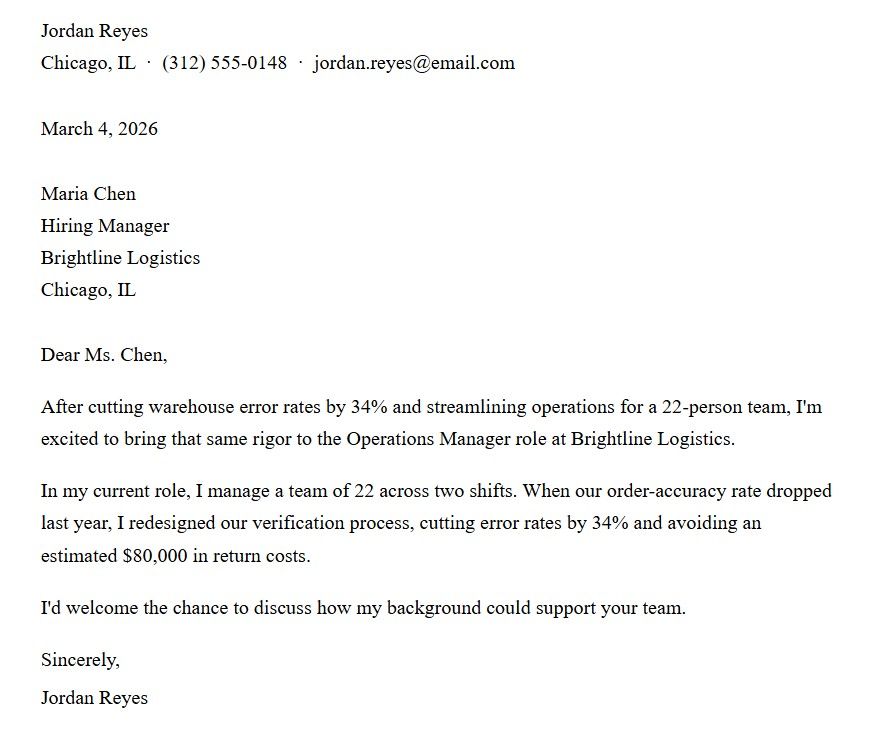
2. No-Experience/Recent Graduate Cover Letter
Best for: entry-level roles, internships, first job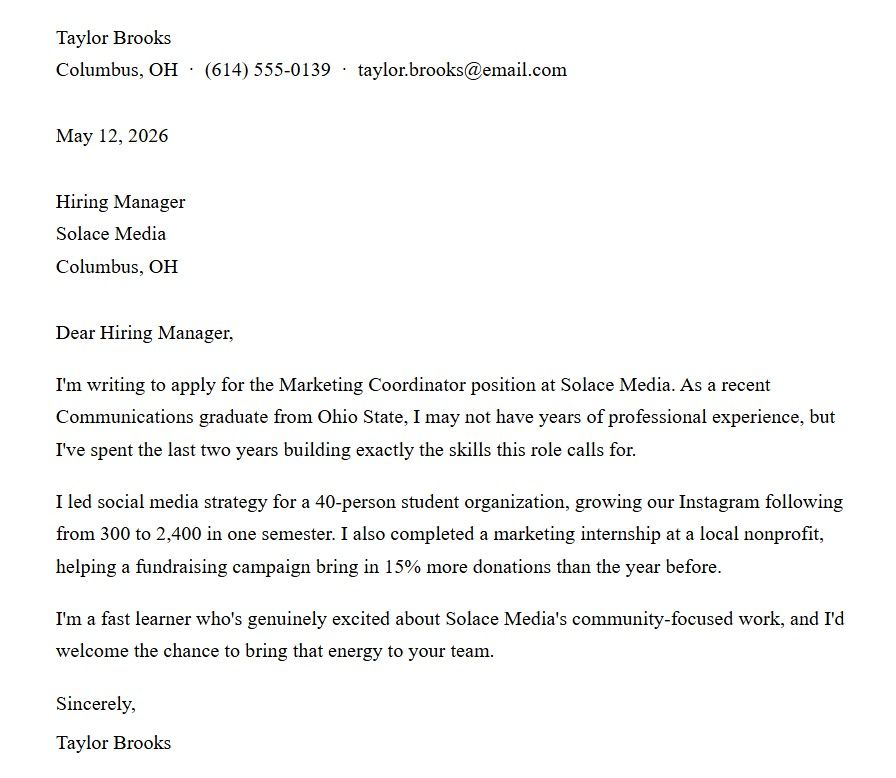
3. Career Change Cover Letter
Best for: switching industries or roles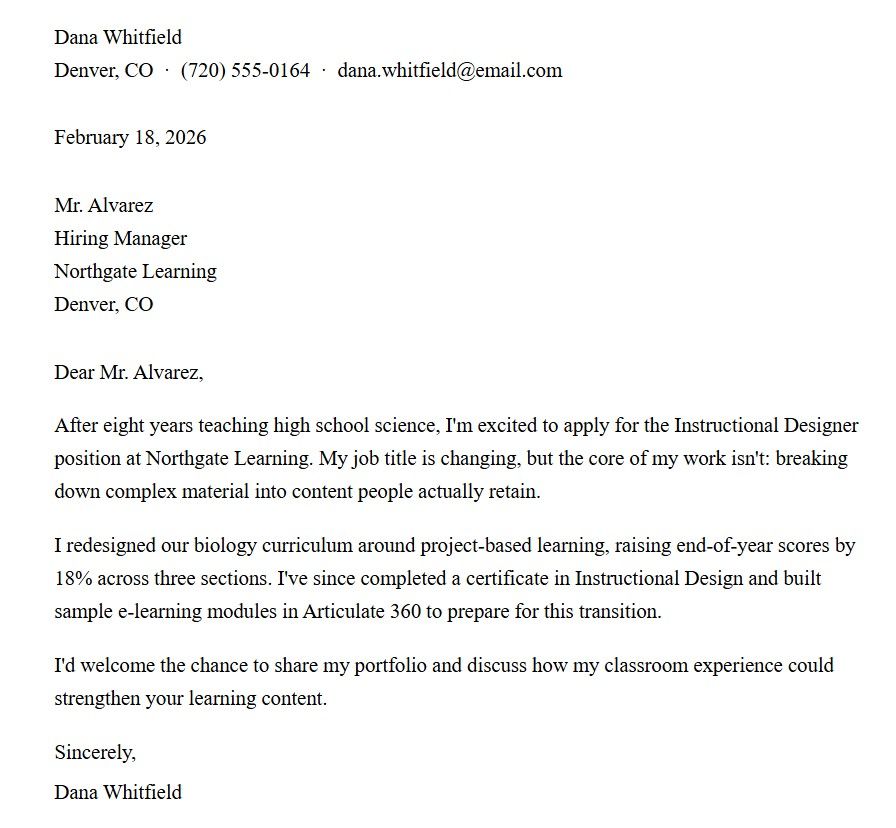
These are just a few examples of cover letters you can use alongside your resume. If you are looking for something more specific, check out our guides on writing a cover letter for a receptionist with no experience or a cover letter for a supervisor position for more examples.
Cover Letter Template Ready to Use
Here is a ready-to-use cover letter template so you can copy, paste, and customize it based on your job description and background.
[Your Name]
[City, State]
[Phone Number]
[Email Address]
[Date]
[Hiring Manager's Name]
[Job Title]
[Company Name]
[City, State]
Dear [Mr./Ms./Mrs. Last Name],
With [X years] of experience in [industry/field] and a track record of [key skill or achievement], I'm excited about the opportunity to bring that experience to the [Job Title] role at [Company Name].
In my current role at [Current/Previous Company], I [specific achievement with a measurable result, e.g., "reduced processing time by 20%"]. I also [second relevant achievement], which [quantified outcome]. I'm particularly drawn to [Company Name] because [specific reason tied to their mission, product, or recent news].
I would welcome the opportunity to discuss how my background in [skill/area] can contribute to [Company Name]'s goals. Thank you for your time and consideration.
Sincerely,
[Your Name]
Common Cover Letter Mistakes to Avoid
- Sending generic cover letters. Recruiters can notice copy-paste or AI-generated content. If you are using AI as a starting point, these best AI cover letter generators can help you tailor each one to the specific job description.
- Repeating your resume. Your cover letter should add context that your resume can’t fit. Avoid repeating the same bullet points, only rewritten in the paragraphs.
- Going over one page. Keep it 250-400 words. Longer cover letters get skimmed quickly.
- Skipping proofreading. Typos and misspelled names can leave a negative impression. Read it aloud and double-check the hiring manager’s name before sending.
Cover Letter Tips
An effective cover letter includes the five important parts: header, greetings, hook, body, and closing. Before you start writing your cover letter, consider the following tips:
- Think of how your experiences, skills, and qualifications relate to the job description.
- Research the company before you apply. Learn their values and both the positive and negative sides.
- Focus on the most relevant skills. Include only the experiences and qualifications that are related to the job description.
- Use specific and measurable examples where possible.
- Tailor it to the job description. Avoid sending the same generic cover letter for every application.
If you’re starting from scratch or need to tailor your existing one, use our AI Cover Letter Builder to create yours within minutes.
FAQs
Is a cover letter still necessary in 2026?
Yes. Not every job lists it as a “must” document to submit, but having one is a competitive advantage. It can help you fill in the gaps and explain things you couldn’t fully cover in your resume. For a deeper breakdown of when you can skip it, see our guide on is a cover letter necessary.
How long should a cover letter be?
Keep it to one page maximum. 250-400 words is enough to explain things straight to the point. Recruiters don’t have time to read essays.
What's the best font and format for a cover letter?
Use Arial, Calibri, or Helvetica, set at 10-12pt to keep it simple and professional. Save it as a PDF file unless the employer requests otherwise.
Can I use AI to write my cover letter?
Yes. There are plenty of AI tools online that can help you generate your cover letter, whether you are a beginner or a professional, like the AI cover letter generator from TailoredCV. Before submitting the final version, edit it for grammatical errors and typos, and add a human touch.
Can I reuse the same cover letter for multiple jobs?
No. Avoid sending the same generic cover letter to each job application. Recruiters now use ATS filters and filter cover letters to find the best fit. That’s why you should tailor your cover letter to each job description and use relevant keywords. You can use the same header, like contact info and your portfolio, but you should update the rest.
What should I not say in a cover letter?
Avoid using outdated or unprofessional greetings like “Hi” or “To Whom It May Concern”. Also, don’t add clichés that don’t add any value to your cover letter, like “I am a team player”. Don’t include salary expectations, personal conflicts, unrelated personal stories, or random hobbies. Keep your cover letter focused on the job description, relevant to the role, and straight to the point.
How to write a cover letter with no experience?
Focus on transferable skills instead of job history. Pull examples from coursework, internships, volunteer work, or student organizations. Skip any apology for lacking experience; lead with enthusiasm and a specific, relevant achievement instead. The structure stays the same, just tailored to show what you can offer rather than what you're missing.
Can I use ChatGPT to write a cover letter?
It depends. You can use ChatGPT as a starting point for brainstorming, but you need to edit the final output. Sending it without editing is risky because hiring managers can easily spot robotic and generic text.
Marija K.
LinkedIn ↗Legal Consultant & HR Specialist
Marija is a seasoned legal consultant and HR specialist with a passion for helping professionals craft standout CVs and navigate complex career transitions.
Ready to tailor your resume?
Let AI match your resume to any job description in seconds — and land more interviews.
Get started free →