
Create & Apply
Analyze & Prepare
Free Tools
All Free Tools
Browse keyword extractor, ATS checker, bullet rewriter, and more
Keyword Extractor
Extract skills and keywords from any job description
ATS Resume Checker
Check resume keyword match against a job description
Bullet Rewriter
Rewrite resume bullets with stronger impact
Summary Generator
Generate professional resume summary variants
Build your perfect tailored CV
Join thousands of professionals landing more interviews with AI-powered resumes.
Popular Roles
See real resumes that get interviews
Browse examples across every industry and role to inspire your own.
Find your perfect template
Professionally designed layouts ready to tailor to any job.
Learn & Explore
June 19, 2026
·7 min read
How to Shorten Resume to One Page Without Losing Value
Learn how to shorten resume to one page without losing the most important information. Cut unnecessary details and keep every section clear and impactful.
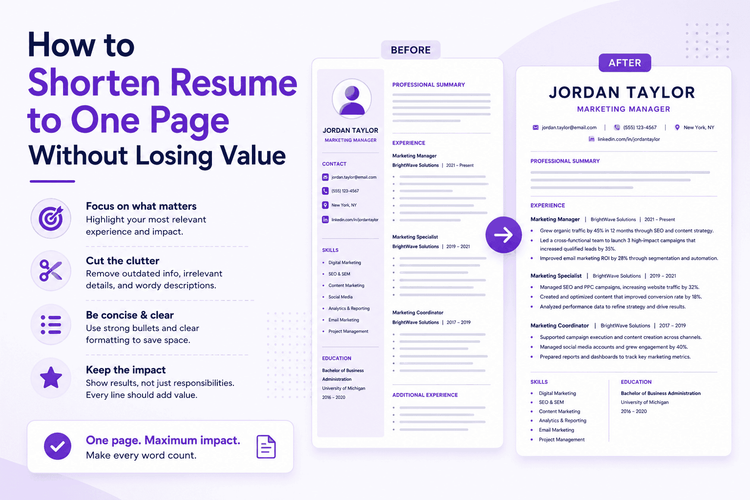
How to shorten a resume to one page is one of the most common challenges for job seekers. Especially if they have many years of experience and struggle not to lose important information.
You know that recruiters don’t spend too much time reviewing resumes. They skim it within seconds, so it is important to make yours clear and concise.
In this guide, we will help you how to shorten your resume while keeping all key information. You will learn which sections to prioritize, how to structure them, and what to remove, so you have a professional resume that captures employers' attention.
Why Use a One-Page Resume
Using a one-page format makes it easier for hiring managers to skim and understand your resume. They now use ATS systems that filter the most suitable candidates for the job.
So, keeping it simple and precise with relevant skills, keywords recruiters look for, and key achievements is important because:
- It makes it easier for recruiters to read quickly.
- It highlights the most relevant accomplishments.
- It improves readability.
- It focuses on information that matters the most for the role.
- It increases the chances of passing the ATS filters.
- It helps employers identify your value at a glance.
When Is a Two-Page Resume Acceptable?
A two-page resume is considered appropriate in certain fields, including research, engineering, academia, and other similar positions. It is also acceptable for professionals who have 10+ years of experience with multiple certifications, publications, or other significant achievements.
For example, in the UK, the two-page CV is standard. In Europe and the USA, they accept a two-page format if you are a professional and need a longer resume.
However, even in longer CVs, every section should remain relevant and tailored to the job position, avoiding fluff information that will only make your resume overlooked.
How to Shorten Resume to One Page Without Losing Key Details
Let's now focus on how to optimize your resume to one page without cutting relevant sections.
Remove Old Work Experience or Irrelevant Information
Analyze your resume and remove any irrelevant work experience that doesn’t connect to the job you’re applying for. Also, if there is an outdated job or hobby that adds no value to your resume, you should remove it.
Focus on who you are today, and avoid listing everything you’ve done in your life.
For example, you don't have to list references, as your recruiters already know that. Or adding 2012 job experience that’s no longer relevant.
If you have multiple degrees in the same field, you can include only the highest qualification, as the earlier ones are assumed. This is how you will save space.
Start With Your Most Recent Experience
List your work experience in reverse chronological order, from the most recent to oldest. Hiring managers want to see what you are doing now, not what you did 10 years ago.
This best reflects your present skills, responsibilities, and expertise. Include old positions only if they are relevant to the job position and demonstrate your career path.
Simplify Sections With Bullet Points
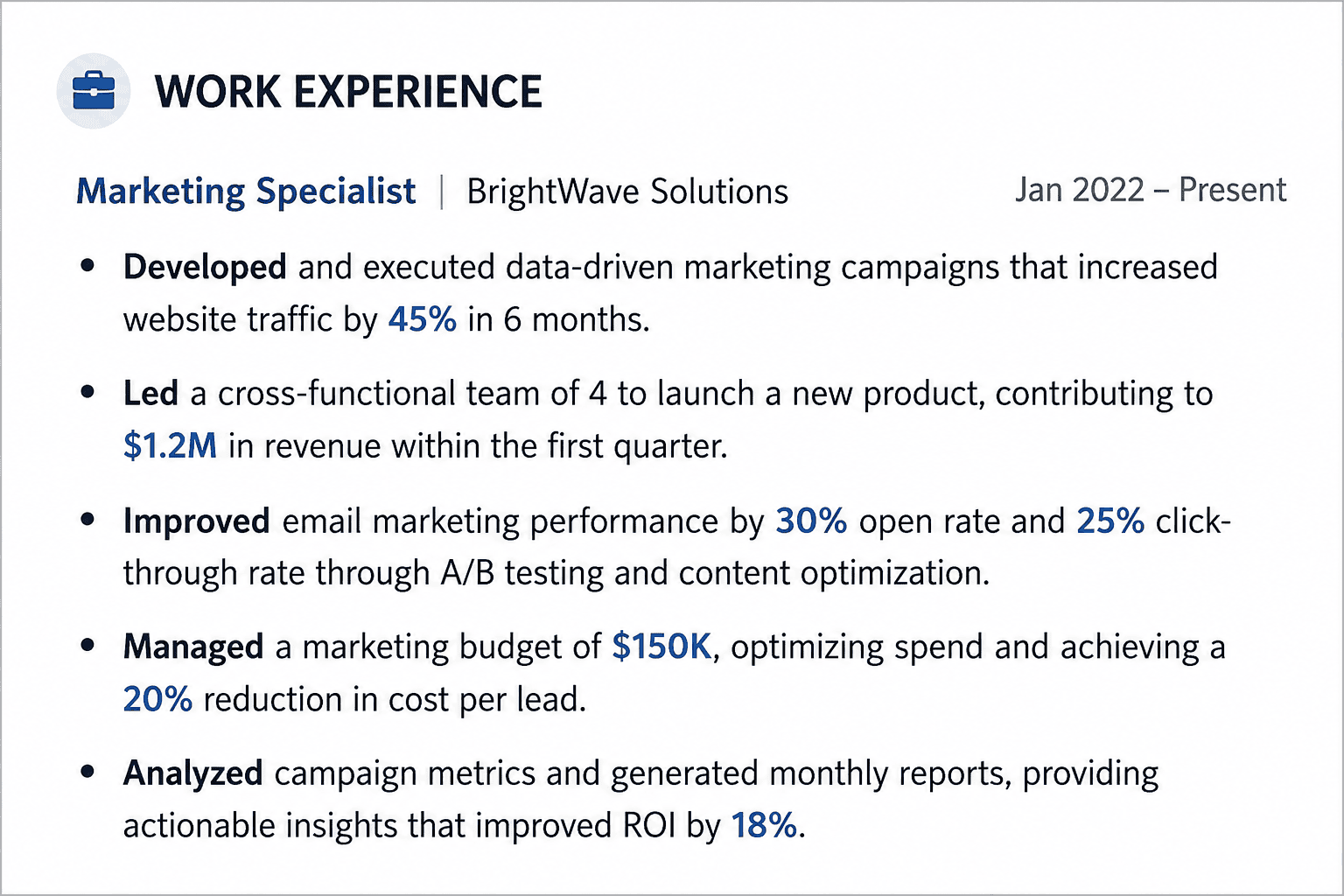
Explain each section with short and simple bullet points. They will help you focus on the strongest achievements, using relevant keywords and action verbs such as developed, led, improved, etc.
Use 3-5 bullet points for each section for better readability. Add numbers or measurable results that add value. This way helps you present your resume in a more concise and structured way, ensuring your focus is on your most relevant achievements.
Merge Sections (Where Possible)
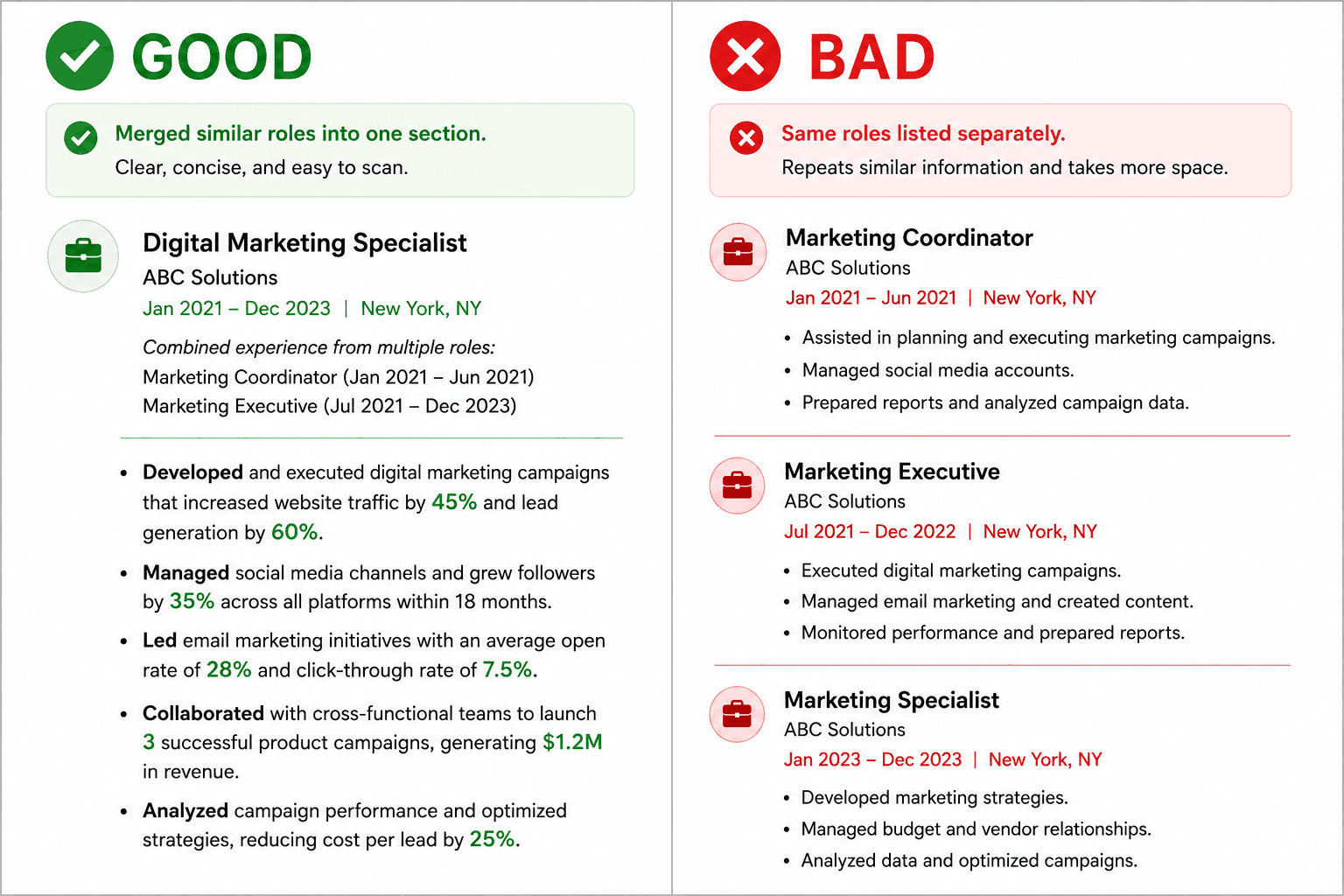
If you have more related job experiences in your CV, make sure you combine them into one single section. For example, similar roles, short-terms contracts that can be listed under one job title.
This will help you adjust space, avoid repetitions, and make your resume easy to scan.
Or you can use this Digital Marketing Specialist CV Builder and create your own resume.
Implement Format Adjustments
This is the most important resume tip to remember when structuring your resume. How you will structure it depends on several factors:
- Reduce page margins: This is one of the easiest ways to save space. Make it look tidy by leaving a small margin between the content and the edge of your document.
- Reduce line spacing: Another way to save space is to reduce the line spacing between the sections, paragraphs, and bullet points. A good line spacing is from 1.0 to 1.15 without wasting space, and for better readability.
- Reduce font size: To keep everything in order, adjust the font size of each section.
| Element | Recommended Size |
|---|---|
| Name | 18–24 pt |
| Section Headings | 12–14 pt |
| Body Text | 10–12 pt |
| Bullet Points | 10–12 pt (same as body text for consistency) |
- Avoid design features: Avoid using icons, borders, tables, diagrams, or other visual design elements that may look appealing but also make it harder for your CV to pass through the ATS systems. These take up your space unnecessarily, which could be used for your actual experience and skills. Use bold or italic when you really want to emphasize crucial details.
And if you are not sure which format works best for you, learn the best resume format 2026 that can get you past the ATS systems.
Common Mistakes to Avoid When Shortening Your Resume to One Page
Shortening your CV can be challenging, so it is normal for job seekers to make mistakes. To help you stay focused and effective, here are the most common mistakes you should avoid.
- Generic language: Phrases like “responsible for various tasks” are too vague and and don't add value. Be specific and show measurable results of what you’ve actually achieved.
- Keyword stuffing: Keywords are important, but don’t overdo it. It makes it harder to read and can feel unnatural and repetitive.
- Complex formatting: Focusing on creativity rather than simplicity will make your CV be ignored by ATS systems and recruiters, too. Keep a minimalistic design unless otherwise specified (e.g., UX/UI designers, interior designers, and similar roles).
- Long paragraphs: Long sections and sentences are hard for recruiters to skim, making them overlook your key achievements. Use bullet points to improve readability.
Tips to Shorten Your Resume Effectively
When shortening your resume, you need to be careful not to remove value sections. The main goal is to remove unnecessary content and white spacing while making room for all relevant information.
- Relevance matters. Tailor your resume to each job description.
- If you are a beginner or recently graduated, list only relevant skills, certifications, and achievements. This No Experience Resume template will help you.
- Keep your professional summary short and concise. Avoid repet the same responsibilities.
- Analyze the job description to include only relevant keywords, not writing fluff content.
- Use a two-column layout if needed. If one-column format isn’t enough for you, divide your sections into two, more compact columns.
However, if not sure, test your resume at one of the best ATS resume checker tools 2026 before applying.
Shorten Your Resume With TailoredCV
Learning how to shorten your resume to one page can be stressful, especially if you have several years of experience. When tailoring your resume, make sure you naturally remove excess information and highlight what truly matters to recruiters and ATS systems.
With the right approach, you can keep your resume concise, impactful, and easy to read. With TailoredCV’s ATS-friendly templates, you can quickly create one page resume with all the important parts in place.
FAQs
How to shorten my resume to one page without losing important experience?
Focus on the most relevant work experience to the job you are applying for. Keep each sentence concise, with 3-5 bullet points to highlight your key accomplishments. Avoid fluff content and include measurable results for better readability.
What to remove from a resume to fit one page?
To make a space for all the important information in your one-page resume, remove fluff content, repetitive sections, and skills. Remove extra page margins, white spacing, and line spacing, and avoid visual elements like borders, stickers, and similar that don’t look professional and take up space. Adjust the font size of each section according to the table we've mentioned earlier.
How to list my jobs on one page if I have 10+ years of experience?
To fit 10+ years of experience on one page, focus on relevance and impact instead of listing everything in detail. Start with the most relevant job, summarize your work experience into bullet points, and remove outdated or repetitive skills. Keep your format clean and skimmable.
Marija K.
LinkedIn ↗Legal Consultant & HR Specialist
Marija is a seasoned legal consultant and HR specialist with a passion for helping professionals craft standout CVs and navigate complex career transitions.
Ready to tailor your resume?
Let AI match your resume to any job description in seconds — and land more interviews.
Get started free →