
Create & Apply
Analyze & Prepare
Free Tools
All Free Tools
Browse keyword extractor, ATS checker, bullet rewriter, and more
Keyword Extractor
Extract skills and keywords from any job description
ATS Resume Checker
Check resume keyword match against a job description
Bullet Rewriter
Rewrite resume bullets with stronger impact
Summary Generator
Generate professional resume summary variants
Build your perfect tailored CV
Join thousands of professionals landing more interviews with AI-powered resumes.
Popular Roles
See real resumes that get interviews
Browse examples across every industry and role to inspire your own.
Find your perfect template
Professionally designed layouts ready to tailor to any job.
Learn & Explore
May 5, 2026
·10 min read
Europass CV Format: Example, Usage & Writing Tips
A Europass CV format is a standardized format widely used across European countries. In this post, we’ll guide you through easy steps to create a standout Europass CV, pros and cons, and practical writing tips.
Looking to apply for a job in Europe? A Europass CV format is a standardized format widely used across European countries. It allows employers to easily assess your qualifications, experience, and skills. However, simply filling out the standard template won't make your CV stand out. In this post, we’ll guide you through easy steps to create a standout Europass CV, choose the best Europass CV template, and get noticed by hiring managers in Europe, no matter where you're from.
What is Europass CV Format?
A Europass CV is a standardized template that helps job applicants in Europe present their skills, qualifications, and experiences in a clear and concise way. It was created by the European Union to make it easier for employers and education institutions to evaluate a candidate's credentials across different countries.
Besides the crucial sections that every CV should include, the Europass CV format presents unique features, including:
- Languages based on CEFR levels (A1–C2).
- Option to include nationality in the personal information.
- Skills organized in separate categories.
- Optional section to attach supporting documents.
It is designed to make the information easy to read and understand for recruiters across Europe. Using this format also helps ensure that your CV meets the requirements of employers from multiple European countries, providing consistency and familiarity.
When to Use (and Avoid) the Europass Format CV
The Europass CV format structure is not applicable to every job application and everywhere.
When to Use
- If you apply for a European job position.
- If employers strictly require using the Europass CV format in the job description.
- Application systems only accept the standardized Europass format.
- If you are a beginner and applying for an entry-level position in Europe.
When to Avoid
- If you want your CV to stand out. The Europass CV format has certain drawbacks.
- If you want a one-page CV. The Europass CV isn't the best option.
- For job applications in the UK, they find it outdated or too generic.
- If you need a more flexible format to reflect your style and tone.
Europass CV Format Structure (+Example)
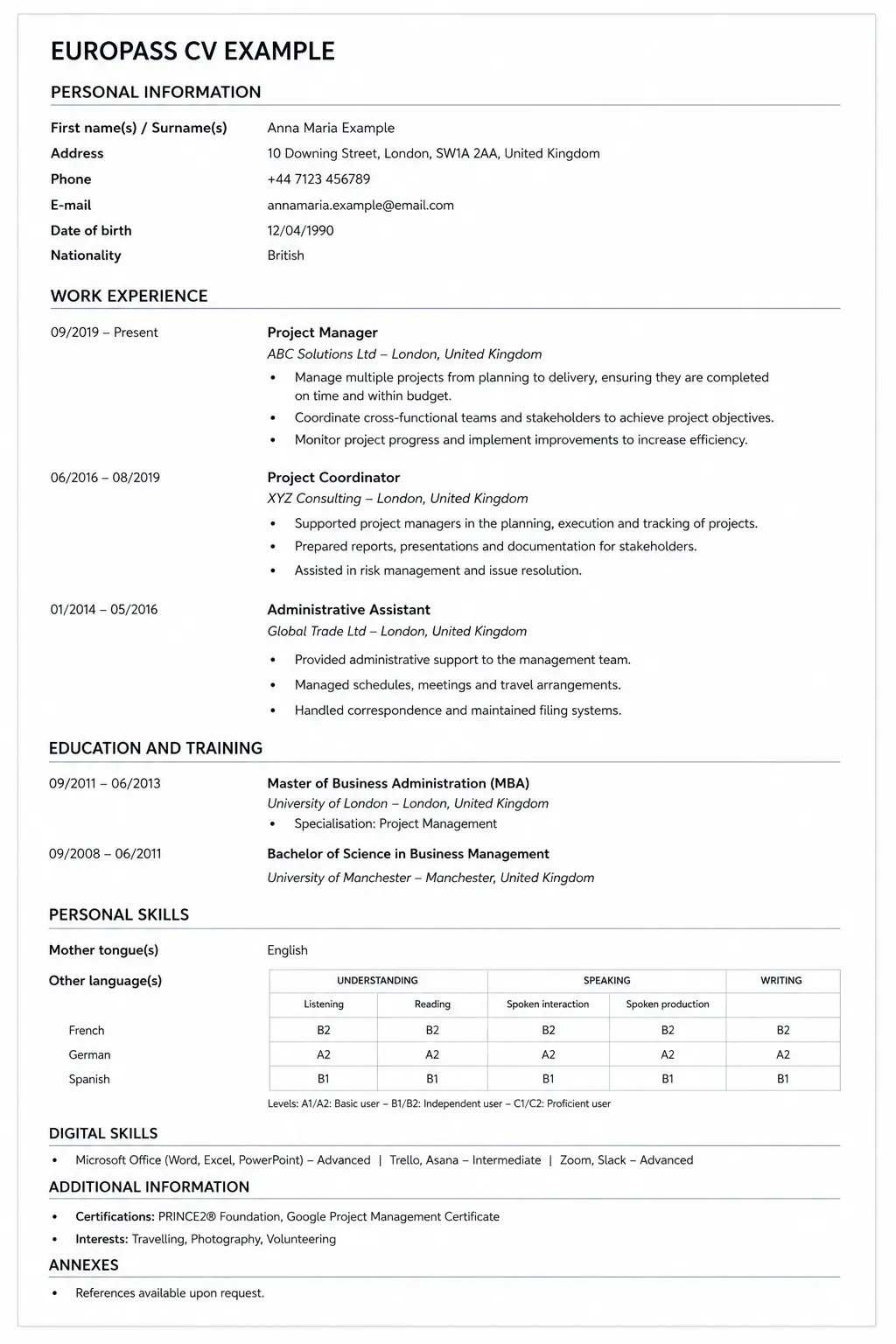
Let's take a look at the common structure of the Europass CV format.
- About me - This is the professional summary section, which allows you to immediately capture the employer’s attention by highlighting your key achievements, strengths, and career focus.
- Personal information - Your name, contact details, address, date of birth, and optional your photo and nationality.
- Work experience - List your work history related to the job description in reverse chronological order, including job title, employer, dates of employment, and a summary of your main responsibilities.
- Education and training - Add your education or training regarding the job you are applying to. If you have a Europass profile, list them there together with your work experience and choose which one to include or exclude in your Europass CV.
- Language skills - Use the CEFR levels to assess your language abilities.
- Digital skills - List your computer skills and tools you are proficient in.
- Communication skills - A separate section to include your communication skills.
- Job-related skills - Add hard and soft skills related to the job you are applying to.
Europass CV Format Pros and Cons
| Pros | Cons |
|---|---|
| Widely recognized across Europe – Preferred in EU institutions and public sector roles | Too long and detailed – Exceeds the ideal 1–2 page CV length |
| Standardized structure – Makes it easy for recruiters to navigate familiar sections | Limited customization – Limited to tailor for specific roles or industries |
| Covers all key information – Includes languages, skills, and qualifications in detail | Repetitive content – Similar information may appear in multiple sections |
| Built-in language framework (CEFR) – Clearly shows proficiency levels | Not ATS-friendly in all cases – Formatting may not perform well in some systems |
| Free and easy to create – Available via official EU tools | Outdated perception – Many private-sector recruiters prefer modern CV formats |
| Helpful for early-career candidates – Provides clear guidance and structure | Weak personal branding – Hard to stand out visually or strategically |
| Supports international mobility – Designed for cross-border job applications | Less effective outside Europe – Not widely used globally |
How to Create a Europass CV
Creating a Europass CV can be simple, but if you want yours to stand out, it’s important to pay attention to certain details. You can either create a Europass profile and decide what to include in your CV from there, or you can create a Europass CV manually.
Whichever option you choose, follow these easy steps to craft a Europass CV that highlights your qualifications and grabs the attention of recruiters.
1. Gather Necessary Personal and Professional Details
Collect all the necessary personal and professional details you’ll need. This includes:
- Full name, contact information, and a professional email address.
- Your educational background (degrees, certifications, etc.).
- Work experience, including job titles, company names, and dates.
- Languages you speak and your proficiency level.
- A list of relevant skills, such as technical or soft skills.
Having all this information organized will make it easier to fill in your Europass CV template and present yourself as a well-rounded candidate.
2. Choose the Right Structure and Layout
The Europass CV template offers a consistent structure that is widely recognized across Europe. While it's tempting to make major changes, it's important to stay close to the template's guidelines for clarity and uniformity. Focus on these elements:
- Choose an ATS-friendly template.
- Keep it simple and professional.
- List your experience in reverse chronological order (most recent job first).
- Include your highest level of education first, followed by any relevant certifications.
- Clearly define both hard (technical) and soft skills (communication, teamwork, etc.).
You can personalize the layout a little but don’t stray too far from the established template to ensure your CV remains readable and accessible.
For inspiration, you can look at examples like an Architect resume example оr a Biotechnologist resume example to see how different professions highlight their skills and experience.
3. Highlight Skills and Experiences Effectively
Your skills and experiences are what make you a strong candidate, so be sure to highlight them in the most effective way possible. Use bullet points to list achievements and responsibilities under each job, and try to quantify results (e.g., increased sales by 20% or managed a team of 10 people). Resumes that will get you hired are those that clearly highlight your skills, achievements, and value to employers.
4. Customize for a Specific Job Application
While the Europass CV format is standardized, tailoring your CV for a specific job application can make all the difference. Research the job description and incorporate relevant keywords hiring managers look for. This ensures your CV passess the ATS systems too.
For example, if the job asks for proficiency in a certain software, be sure to highlight your experience with that tool. Customizing your CV to align with the job you're applying for shows you're a good fit for the role and makes your application stand out.
5. Review and Proofread
Before submitting your Europass CV, take time to review it carefully. Look for any errors in spelling, grammar, or formatting. Even small mistakes can make a big difference when applying for a job.
An error-free CV reflects professionalism and attention to detail. A clean CV is more likely to make a strong impression on recruiters and will reflect your commitment to presenting yourself in the best possible way.
Europass CV Writing Tips
To make your Europass CV truly stand out, focus on these key areas:
- Tailor it to the job: As mentioned earlier, customizing your CV to the job description is essential. It shows that you are invested in the role and understand what the employer is looking for.
- Show your personality: Even within the formal format of a Europass CV, there’s room for personality. Be authentic in how you describe your skills and experiences.
- Use action verbs: Words like "managed," "led," "designed," or "created" can make your accomplishments sound more impactful.
- Include additional sections: Add sections manually to strengthen your CV. Enhance your application by including certifications, projects, volunteer experience, and any additional achievements that help you stand out from other candidates.
Europass format CV vs. UK format
A modern UK CV template differs from the Europass format. Let's compare them side by side.
| Feature | Europass CV Format | UK CV Format |
|---|---|---|
| Purpose | Standardized CV designed for use across European countries | Flexible CV tailored to specific jobs in the UK job market |
| Structure | Fixed, highly structured template with predefined sections | Flexible structure, arranged based on relevance to the job |
| Length | Often 2–4 pages due to detailed sections | Usually 1–2 pages, concise and focused |
| ATS Friendly | Moderately ATS-friendly, but formatting can be rigid | Highly ATS-friendly due to simple, clean formatting |
| Customization | Limited customization due to standardized format | Highly customizable for each job application |
| Style | Formal, uniform, and standardized | Professional, concise, and results-oriented |
| Use Case | Best for EU institutions, education, and cross-European applications | Best for UK private sector and competitive job applications |
The Europass CV is best suited for standardized applications across Europe, especially in academic or institutional settings, but it offers limited flexibility and customization. In contrast, the UK CV format is more concise, highly adaptable, and ATS-friendly, making it more effective for competitive job applications in the UK job market. In fact, many candidates now use the best AI resume tailoring tools 2026 to optimize their CVs for specific job descriptions and improve their chances of passing ATS filters.
How TailoredCV Enhances Your Europass CV
While the Europass CV format is a great starting point, building a standout CV requires more than just filling in a template. That’s where TailoredCV comes in. Our AI Resume Builder offers personalized guidance to help you:
- Optimize your CV layout for maximum impact.
- Choose the most relevant skills and experiences for the job you’re applying for.
- Customize your CV with professional language and design elements to make it stand out.
- Save time with pre-made templates and step-by-step instructions.
Whether you're applying for your dream job or looking to stand out in a crowded field, TailoredCV provides tools and insights to elevate your CV and help you land interviews.
Frequently Asked Questions
Who uses Europass CV format?
The Europass CV format is mainly used by job seekers across European Union countries, especially when applying for roles in EU institutions.
Can I download a Europass CV template?
Yes, you can download and create a Europass CV online for free through the official Europass platform. It provides ready-made templates and an online builder that automatically formats your information into the Europass structure.
How to format a European CV?
A European CV (Europass style) should include clear sections such as personal information, work experience, education, skills, languages, and additional information. The format is structured, chronological, and uses standardized headings to ensure consistency across countries.
Should I use a Europass format CV?
You should use a Europass CV if you are applying within Europe or for roles where a standardized format is required. However, for competitive jobs, especially in countries like the UK, a more tailored and concise CV format is usually more effective.
Is Europass CV format easy to use?
Yes, the Europass CV is easy to use because it provides a step-by-step online builder and a pre-designed structure. However, it can be less flexible when you want to highlight achievements in a more personalized way.
Marija K.
LinkedIn ↗Legal Consultant & HR Specialist
Marija is a seasoned legal consultant and HR specialist with a passion for helping professionals craft standout CVs and navigate complex career transitions.
Ready to tailor your resume?
Let AI match your resume to any job description in seconds — and land more interviews.
Get started free →