
Create & Apply
Analyze & Prepare
Free Tools
All Free Tools
Browse keyword extractor, ATS checker, bullet rewriter, and more
Keyword Extractor
Extract skills and keywords from any job description
ATS Resume Checker
Check resume keyword match against a job description
Bullet Rewriter
Rewrite resume bullets with stronger impact
Summary Generator
Generate professional resume summary variants
Build your perfect tailored CV
Join thousands of professionals landing more interviews with AI-powered resumes.
Popular Roles
See real resumes that get interviews
Browse examples across every industry and role to inspire your own.
Find your perfect template
Professionally designed layouts ready to tailor to any job.
Learn & Explore
May 28, 2026
·6 min read
Difference Between Cover Letter and Resume (+ Writing Tips)
When you're applying for a job, most postings ask for both a resume and a cover letter. A resume and a cover letter go to the same person, represent the same candidate, and often get written back to back.
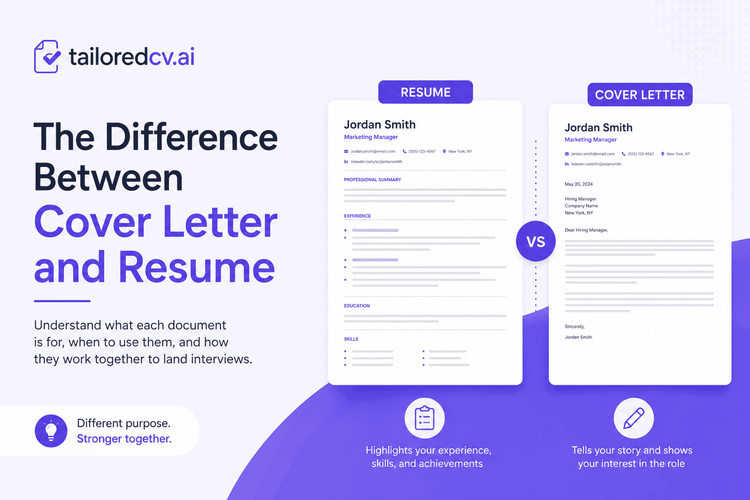
When you're applying for a job, most postings ask for both a resume and a cover letter. A resume and a cover letter go to the same person, represent the same candidate, and often get written back to back.
But, they're doing completely different jobs, and mixing them up (or treating one like a copy of the other) is one of the fastest ways to hurt an otherwise strong application.
Each document serves its own purpose in your application, and understanding that distinction is what helps you write both of them well. Below, we’ll go over the difference between cover letter and resume and explain the importance of both.
What Is a Resume?
A resume is a structured overview of your professional background. It documents your work experience, education, skills, and key achievements in a format that's easy to scan quickly. Remember, hiring managers often spend only a few seconds scanning your resume before deciding whether to reach out.
When writing your resume, you also need to tailor it for ATS, which is software that most companies use to filter applications by keywords. That means formatting and keyword choices matter just as much as content.
A standard resume includes:
- Contact information (name, email, phone, LinkedIn, location)
- Professional summary (2–3 sentences that frame who you are as a candidate)
- Work experience in reverse chronological order, with bullet points focused on the results, not the job description
- Education, certifications, and relevant coursework
- Skills, both technical and transferable
- Optional sections like projects, publications, volunteer work, or languages
In terms of length, one page is standard for early-career candidates, and two pages is acceptable for professionals with more extensive experience. The formatting should be clean and simple, so no heavy graphics or images (common mistake among freshers). Follow our resume writing tips to ensure you get a tailored resume.
What Is a Cover Letter?
A cover letter has one job: to explain why you're applying to this role at this company, and why that makes you a good fit based on your background. While your resume covers what you've done, your cover letter explains why you decided to hit the “Apply” button.
It's also your chance to address anything the resume can't. If you're changing industries, a cover letter lets you reframe your experience in a way that's relevant to the new direction. If there's a gap in your employment history, you can acknowledge and contextualize it. If you have a strong connection to the company's mission, that's the place to say so.
A standard cover letter includes:
- Your contact information and the date
- A proper salutation addressed to the job poster
- An opening paragraph that names the role and gives the reader a clear reason to keep reading
- One or two body paragraphs connecting your experience to what the role requires, with a specific example or two
- A short explanation on what got you interested in the position
- A closing sentence that thanks the reader and asks for a follow-up
It goes without saying that a cover letter should not be a long version of your resume. If you're simply repeating everything that's already listed, you're wasting the reader's time and missing the point of a cover letter. So, be as specific as possible as to why you want the job.
For a lot of people, writing cover letters feels like a chore, especially if you have to tailor each one to many different job applications. An AI cover letter generator can cut your time in half, if not more.
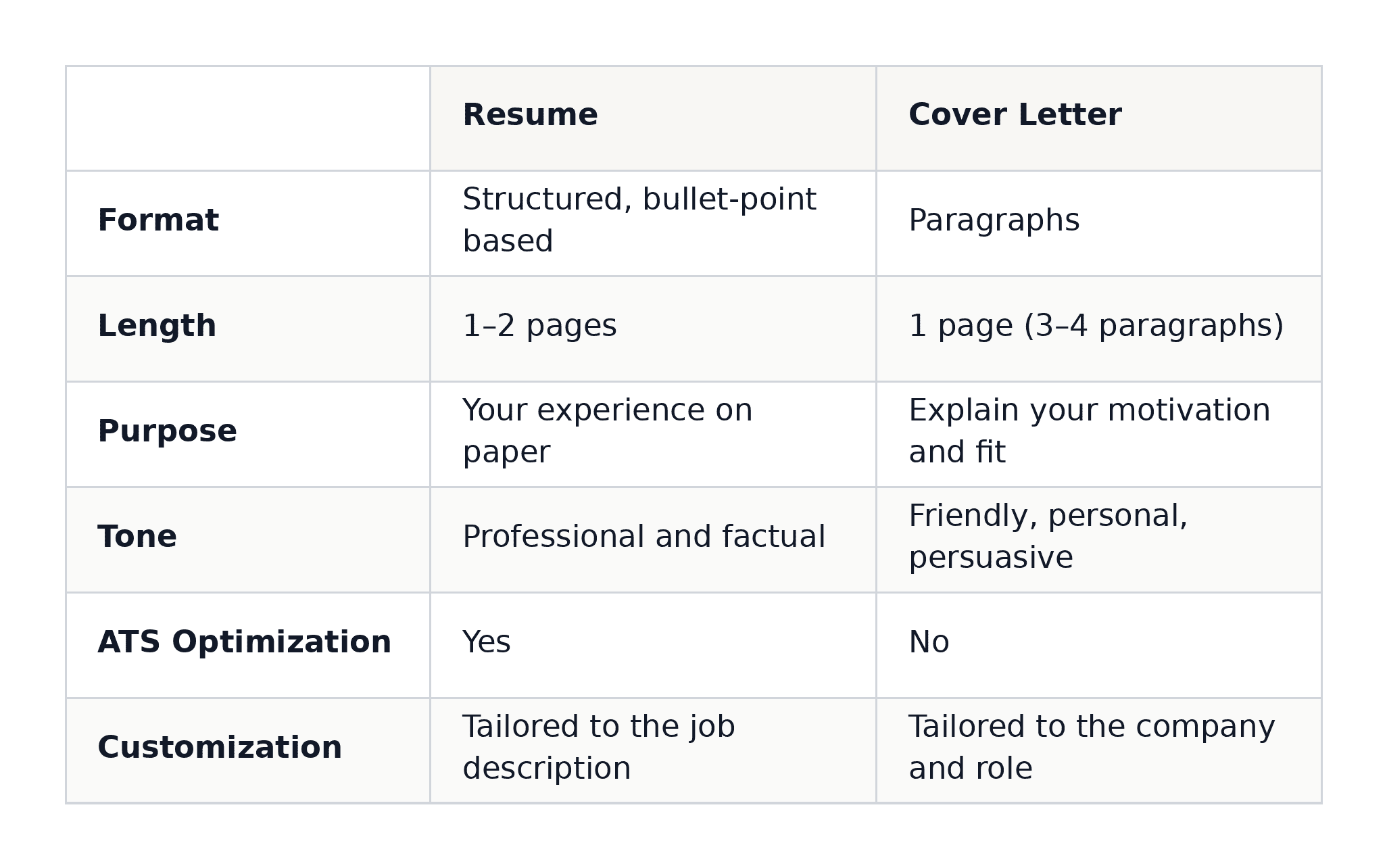
How They're Different (In Plain Terms)
The clearest way to think about cover letter vs. resume is this: your resume answers "what have you done?" and your cover letter answers "why does this matter for this job?" That’s why they go hand-in-hand.
Do You Always Need a Cover Letter?
No, you don’t have to submit a cover letter with every job application. If there is a need for one, the application form will give you the option to attach a cover letter. Mind that if the cover letter field says “optional,” it’s still better to send one in – it will separate you from the other applicants who will happily skip it.
Tips for Matching Your Resume and Cover Letter
The most effective applications treat the resume and cover letter as a coordinated pair rather than two separate documents. Here are a few ways to do that:
- Pick two or three key points before writing either. If leadership, technical depth, and cross-functional collaboration are the most relevant things to highlight for a given role, let those threads run through both your resume achievements and your cover letter narrative. Consistency reinforces the same impression from two directions.
- Treat the cover letter as an extension of a resume highlight. If your resume mentions that you led a product launch that drove $2M in revenue, your cover letter is where you can briefly explain the context — the problem you were solving, the approach you took, and why it's relevant to what this company is building. The resume establishes the fact; the cover letter gives it meaning.
- Mirror the language of the job description. Both documents benefit from reflecting the vocabulary the employer uses. This isn't about stuffing in keywords artificially — it's about demonstrating that you understand the role and can communicate in the same terms the team uses.
- Use all the tools to your advantage. Use tools to be efficient when applying to many jobs. AI resume builders help you tailor your resume to any job description in minutes instead of having to deal with a writer’s block.
Common Mistakes to Avoid
On your resume:
- Describing responsibilities instead of results. Hiring managers know what a project manager does; they want to know what you achieved.
- Using the same resume for every application. A generic resume rarely performs well in ATS filtering.
- Over-designing. Tables, columns, icons, and graphics can look polished in a PDF viewer but break entirely when parsed by an ATS.
- Including outdated or irrelevant experience. If something doesn't strengthen your candidacy for this specific role, it probably doesn't need to be there.
On your cover letter:
- Opening with "I am writing to apply for..." — it's one of the most common openings and super forgettable. Start with something that gets to the point more directly.
- Summarizing your resume. If the cover letter just recaps what's already in the document, it adds no value.
- Vague enthusiasm. "I've always been passionate about this industry" doesn't tell the reader anything. Specific, grounded reasons are far more convincing.
- Forgetting to ask for the interview. Close with a direct, confident statement that you'd welcome the opportunity to speak further.
Write Both Faster With TailoredCV.ai
Customizing a resume and cover letter for every role takes real time, especially when you're applying to multiple positions at once. TailoredCV.ai generates customized versions of both documents based on any job description, so you get applications that are relevant, keyword-optimized, and ready to submit without rebuilding from scratch every time.
Sign up and see the real difference a custom resume or cover letter makes.
Marija K.
LinkedIn ↗Legal Consultant & HR Specialist
Marija is a seasoned legal consultant and HR specialist with a passion for helping professionals craft standout CVs and navigate complex career transitions.
Ready to tailor your resume?
Let AI match your resume to any job description in seconds — and land more interviews.
Get started free →